Author Archives: Cine Boot Camp Team

How Google Gets You Face to Face With Online Customers

Google


“Google” is a Typo

Google is one of those words that just flies off our tongues these days. But what does “Google” mean? I ask the business owners I work with all the time, and most haven’t a clue, so I thought I’d clear it up.

Google is actually a typo. Or a misspelling. Either way.

The original word is “googol.”  Oddly enough, the word was coined in 1938 by the 9 year old nephew of a mathematician, Edward Kasner. There are probably several versions of this story floating around, but the word is, the new phew (Milton) advised that a number so large should be called something silly, and offered the name “googol.”

How large a number is a googol? Bigger than you can imagine. It’s so big, it’s larger than the number of elementary particles in the universe. Last time I checked, that was pretty big. A googol is the number 1 followed by 100 zeros.

So when the founders of Google were registering the domain name on GoDaddy or whatever they were using, they typed “Google” and it was available. They liked it so they took it. Works for me.

Google: An Essential Part of Off Page SEO

What does the name of Google have to do with Off Page SEO? Not much. But Google itself is essential. Because Google indexes content, and serves that content up based on a user’s provided search terms, one may leverage Google to showcase their web presence. It also is a type of consumer analysis in that one can observe trends and identify words and phrases having a high volume of search requests.

Facebook LogoTwitter

Sites like Facebook and Twitter are indexed very often by Google because of the enormous amounts of new information these sites add daily. For more reasons than one, Facebook and similar social networks quickly make it to the first page of a Google search for relevant terms. If you have 20 social media profiles, and you list your website address on them, a trail is being laid right to your website’s “front door.”

Incorporating Google for an Effective Marketing Plan Online

Content. The most important way to get on the first page of Google (and other search engines) is to provide well-written content.  All web content should utilize keywords (words Google uses to link a request to a specific website or resource on the web.  If you know what keywords your potential customers are searching for already, these words should be incorporated into written articles, blog posts, status updates, etc., whenever possible (but within reason).

A great feature of the web is that content stays up for a long time. Beats that flyer tacked up on a telephone pole that withered into a soggy mess in the last rain! Even better is that there are plenty of free places on the web to post content.

Long Tail Keywords

A long tail keyword is simply a more specific keyword that a well-educated potential customer would be using in their search efforts.  When I say “well-educated” I don’t mean a college graduate. I mean they have done their homework online, and they know what they are looking for. Here’s some examples:

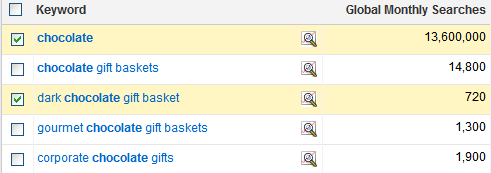
Not a long-tail keyword: Chocolate
Long Tail Keyword: Dark Chocolate Gift Basket
Long Tail Keyword for "Chocolate"

The picture above is a screen shot from Google’s Adwords Tool. Someone searching for the phrase “dark chocolate gift basket” is probably searching for something they are ready (or very soon will be) to buy.  So while there are less people searching, they are also hotter prospects. The other two words listed are also long tail keywords.

Long Tail Keyword Research and Social Media for Business

Social media for business boils down to one thing. Being visible on the 1st page of Google for a relevant search term. Another way to say that is, be one of the 10 vendors actually in the room with the prospect who’s ready to buy.

If you aren’t showing up on the first page of Google for something you sell, you just aren’t in the same room as the prospect. Again, we come to the subject of content. By ensuring the keywords in your articles, status updates and tags contain long-tail keywords that are relevant to your customers, you have a better chance of showing up in the “sales” room. Of course, before you are able to put together appropriate content, the long tail keyword research needs to be done by an experienced marketer. Otherwise a lot of work might go into creating content that is hiding you, not helping you, on Google Searches.

Don’t have a website or a blog? Here’s a few places to start your online presence that show up well on Google searches:

The reason I suggest all of the above sites is because they work insanely well with Google in terms of showing up on search results. Obviously Google Places is part of Google, but the other sites are either geared to be optimized or have a special deal with Google or both.

Of course, there are many other sites, but the sites above are good places to start. Having optimized content is an important factor in an overall campaign, which can and should include traditional media to build awareness, especially if your online presence is new. Try to do both, but at least leverage the free tools at your disposal.

The Key to Online Lead Generation

How many business owners wake up in the morning, and the first thing they think of is what keywords they should be using on their website or blog? Probably not too many. I have to admit, it’s not a very exciting topic. But it is part of an effective marketing plan.

What if I told you that keywords = new clients? That’s right! Skip this morning’s latte at Fourbucks and hunker down for a good read, because, that’s exactly what keywords mean. New Clients.  Why? Because right now, at this very minute, millions of potential customers are searching for products online. For example, here’s a breakdown of some of the most-searched-for insurance keywords according to Google:

Main Insurance Keywords

The “Global Monthly Searches” number represents the number of people searching per month for each keyword. The numbers above are for online searches in English, in the United States, averaged over 12 months.

Lack of keywords (or ineffective keywords) = hiding you from new clients.  Another way to say that is “your site isn’t on the 1st page of a Google Search.” The first step in wrestling this topic to the ground and gaining the upper hand is understanding exactly what keywords are. 99% of the business owners I talk to have only a vague idea what keywords are, usually don’t know if they have any keywords on their websites, and don’t know if they are effective.

“Keyword” is an appropriate name because keywords really are “key” to online lead generation.  Using Google (or similar sites) to search for answers to questions develops keywords.  In other words, the potential client or customer typing into Google’s search service are where keywords come from. They do NOT come from the IT Department, a co-worker, or a brainstorming session. They already exist – they just need to be located. It’s not hard to locate them if you know how to do what’s called “long tail keyword research.”

In the same way that an insurance agent would strive to provide a client with a plan that meets the client’s needs, every website’s written content should strive to match the words and phrases your customers are searching for. In a practical sense, if no one is searching for a particular phrase or term, it’s not a keyword.

It’s similar to getting married.  In this case, the potential prospect is the Groom. He’s got a problem to solve, finding a Bride (i.e., your online presence, such as your website).  Google plays the role of Matchmaker.

When the “Groom” types in a description of what he’s looking for, Google “matches” his description with websites that contain the same words.  There are at least 3 places on a website that Google indexes (kind of like a library indexes books so it knows exactly what it has on the shelves). Each location is an opportunity to place appropriate keywords to help Google do a better, more accurate job of it’s Matchmaker role:

1. The website’s title
2. The website’s description
3. The website’s written content

Out of these 3, which one is the most important for your site?

They all are!  Originally, websites had a list of keywords to define the site’s features, but Google had to stop relying on the keywords list – too many “brides” were listing “qualities” they didn’t really have, creating a bait and switch scenario on searches.  A potential client searching for “life insurance with cash value” might get a website showcasing “Belgium chocolate with almonds” instead. While stuffing a site with irrelevant keywords might work briefly, Google eventually figured it out and now relies on the actual written content of a site.  Other search tools might utilize keywords for search, but Google does not. If it’s written well, Google might also use the Title and Description of the website in it’s search results.

Right about now is when my clients ask me about their website’s title and description. Do they have any? Where are they located in a website?  Actually the title and description have been in plain view on Google search results all along.  Type in “Life Insurance” on Google Search, and you’ll get 10 search results back. Each search result is usually made of 3 pieces of data, 2 of which are the Title and Description (very important to have filled out properly).  Here’s an example:

Hold on! That’s just a Google search result.  How do you look at the Title and description on your own website to check for effective keywords?  Ah, that’s a whole other ball of wax.

Let’s do what Google does, and go to the place in cyberspace where a website’s keywords are stored. It’s easy to get there.  You don’t have click your heels 3 times and say, “there’s no place like home” to get there, but there is sort of a man behind the curtain effect. Kind of like the movie “The Matrix,” there is the visual result of the website’s programming that you can see, and then there is the programming code “behind the scenes” that in-the-know people can access for the real scoop.

Let’s check out what Farmer’s Life Insurance is using for keywords.

These instructions are for PC users*:

1. Go to the site you want to check. In this case, Farmer’s Life Insurance.

1. Using your mouse, right click anywhere on the site except the pictures or images. Alternately, you can use the Shift key while pressing the F10 key at the same time.

1. A little box will open up with a short menu. Click on “View Page Source” (or press Ctrl V).

1. A page will open up showing the programming code that makes up the content of the website. You don’t have to understand the code to find what we are looking for, fortunately.

1. On this new page, right click again (or Shift F10) and click on the “Find Again” option.

1. Locate the Search box that appears at the bottom of the page (on the left) and type in the word “Title.”  As you type, it will start to highlight any matching word on the page.

1. Observe the title in quotes following the highlighted word. Are there any keywords in the title? How about the Description?

1. Try searching for the list of keywords by typing in “keywords” in the search box. Note the keywords Farmers uses.

Just because a big company has listed their keywords on their website doesn’t mean they are good keywords.

Keywords: Helping You or Hiding You?

Earlier we discovered that the word “insurance” is searched for over 55 million times per month. So, obviously, that keyword should be listed EVERYWHERE, and we should include in every sentence on an insurance website, right?

Nope.

The fact is, unless you are prepared to pay a lot of money advertising on Google for ads that show up when the word “insurance” is searched for, it’s too late to show up on the first page of Google for a word as general as “insurance.” There’s just too many other companies already using insurance as a keyword. In other words, the competition for the 1st page is too great.

The way around this is to be more relevant and focus on niche keywords and phrases instead of one-word keywords. Think about how you search for solutions on Google yourself. How many words do you have to type in to refine your search to find something useful?

When fishing for leads and interested customers (and ready to buy), do you want to be in the Olympic-sized swimming pool with 400 screaming kids, their parents, grandparents, a group of bikers, etc? Actually, for the word “insurance,” it’s an ocean, not a swimming pool, of people searching for that term.

Or do you want to appear in the 10-person hot tub with the hot models (I mean prospects) that have already taken off their advertising deflector shields? That’s what using more specific, or more relevant, keywords can do for your website, blog or other web presence: get your site front and center and visible to interested prospects who have already educated themselves through the internet.

Two Kinds of Keywords

There are two kinds of keywords to focus on. The keywords used in the meta data of a website, and the keywords in the content of the site that potential customers actually see. The meta data is within the programming language of the site (remember the keyword search we did earlier?), and the content is all the pages of written words on a site (the pages the consumer sees when they visit). Both are important.

Meta data is data about data. “Meta” as a prefix means “a higher level of description.” A meta-newspaper would be a newspaper describing other newspapers.  Meta data is data about the data on a website. It can also mean “behind,” which is rather apt because the meta data is sort of on a hidden web page “behind” what a prospect sees when they type in a web address.

Each page of a website can have it’s own list of keywords specific to the content of that page in it’s title, description and list of keywords. Being more specific helps your page be more relevant to what a potential customer is looking for. At the same time, the content of the page itself should contain keywords and phrases currently being searched for on Google. Which words to use requires savvy, experience and skill, and some way to measure the results on a regular basis.

Just because keywords are added to a site doesn’t mean Google knows about it instantly. It may take 3-4 months for Google to catch up with your changes. It’s worth hiring someone to research keywords and track a website’s progress, so you can focus on servicing and retaining your client base.

Social Media Keywords

If people can comment on your site and carry on a conversation, or share the site’s content using email or Facebook, etc., you are already using social media. Usually social media refers to sites that specialize in conversations and sharing, like Facebook and Twitter.  Because these sites regularly add fresh content and are so active, they show up well on Google searches. The same with blogs. Similar to a website, Google indexes social media site content and serves them up as search results for user queries.

Researching keywords for social media is similar to, but not the same as researching keywords for a website. Social media sites are so dynamic, so active. Most websites sit around and wait for someone to show up. The two are not the same beasts at all, although a potential customer may not care or notice the difference as long as their question gets answered.

Similarly, researching and using keywords for a regular website is different than researching and implementing keywords for blogs or other corporate social media.

Hopefully this article has empowered you to at least verify your website has keywords listed in the site’s meta data. If you’d like to take it a step further, request a free evaluation of your keywords for either your website, social media content or both. You’ll get a report back showing how the words on your site rank and which ones would be the best to use for your enterprise social media efforts. Personally I feel the most effective is our Topic Optimized Marketing service, which is an enterprise level social media service.

Get started today and optimize your web presence for tomorrow’s searches.

* Attempting to use this instructions on a website that is created using pictures and videos (also known as “Flash”) won’t work as there isn’t any place for the keywords to be listed.

Lemon Law Behind the Scenes Fun

The Association Direct Response TV Ads Clapboard
The Association delves into several facets of marketing and promotion. One of our most effective marketing plans include direct response TV ads. That’s exactly what we did for Norman Taylor and Associates.

At our film production studio we used our green screen stage to help produce the spot for Norm. The green screen allows you to save both time and money by eliminating the repositioning of equipment and costly location expenses. And, if you have a good lighting director, gaffers and grips who work fast, you’ve got more time to get the best performances from your actors. That’s why we decided to use this for Norm’s Lemon Law TV spot.

“Our video shoots not only produce a great product for the client, we manage to have some fun along the way.”- Fletch Murray, Director

Click the video below and see some of the behind the scenes at our recent shoot for Norm’s new Lemon Law TV spots.


"Behind the Scenes" Video for Norman Taylor & Associates, produced by The Association in Burbank, CA

http://www.youtube.com/watch?v=4RD769Modmw

Historical Documentary Uncovered

"Chicano Moratorium: A Question of Freedom" documentary filmed by Tom Myrdahl of The Association

In 1970, The Association’s Director of Photography, Tom Myrdahl, was a graduate film student at Loyola-Marymount, where he became involved in the “Chicano Movement” and began custom video production in documenting their demonstrations. On August 29th, 1970, Tom and his associate Nick Sherbin stood their ground while filming the LA County Sheriff’s police action against the demonstrators attending the “Chicano Moratorium,” a protest against the Vietnam War held at Laguna Park in East L.A.

This documentary, “Chicano Moratorium: A Question of Freedom” was seen by many audiences in Los Angeles in the latter part of 1970, but the film has not been distributed or viewed since then for over 40 years, until now.

Now, in an effort to share his work with the public, Tom is releasing the production for general viewing.  What better place than The Internet?  Tom also recently presented a copy of this work to Professor Mario Garcia, head of the Chicano Studies program at UC Santa Barbara. Dr. Garcia was elated to have this short and accurate depiction of the tragic events of the Aug. 29th police riot. Bert Corona did the original “voice over” for Tom’s documentary and Dr. Garcia recently published his biography of Bert Corona, LA’s legendary Chicano leader.

 Tom also gave a copy of the documentary to Rosalio Munoz, who was one of the original organizers and speakers at the historic Moratorium Event. Rosalio was also pleased to have a copy of Tom’s film. You can also view the film below:

Fun & More Fun With Little Tikes

It’s common knowledge in Hollywood that you don’t want to work with kids or dogs. Video production crews find them to be too unpredictable and therefore too much of a handful. That’s why we continue to have such a good relationship with Little Tikes, the iconic brand name for kiddie toys.

In December The Association shot two spots simultaneously, both to be shown in Toys R’ Us stores. One was for the Little Tikes Outdoor Grill and the other was for the Little Tikes Mudpie Maker. We had a ball watching the kids run around making plastic hamburgers and real mud pies. The Director Theresa Soulliere did a wonderful job in keeping everything calm and organized and at the end of the day everyone was very pleased.

The Association has several areas that he love to work in, such as corporate social media and working with Canon DSLR 5D cameras. However, we also love doing commercial productions and this time around we got to shoot another spot to be shown in Toys R’ Us stores. This shoot was for the Little Tikes Spray & Rescue Fire Truck, a fire truck that pumps real water! Imagine watching kids riding around, spraying water everywhere as they put out pretend fires. It was awesome!

And once again, Director Theresa Soulliere kept everything under control as we shot some very creative spots out of the mayhem. It was great fun for all!

Google Me Filmmaker Jim Killeen on Oprah!

Jim Killeen’s 90-minute documentary, “Google Me,” was recently featured on the Oprah Winfrey Show. The Association is proud of Jim’s stunning achievement in a genre which usually focuses on what’s wrong with the world.

The Association was lucky enough to be involved in Jim’s documentary as he contacted our corporate video production services.  This documentary shows a different view of the world….a world which is not a dangerous place. A world where people will extend the hand of trust and friendship and invite a stranger into their home just because they have the same last name.

The Story Behind the Film:
Jim Googled his name and found six people with the name “Jim Killeen,” including an Irish priest, an Aussie CEO, a wife-swapping swinger and a New York cop. Jim took a video production crew with him as he visited Google headquarters to see the powerful search technology in action, as well as visiting his namesakes in four countries to learn how these very different people are actually quite similar.

If you’d like to restore your faith in mankind, or you’d like to cheer up a friend who’s down in the dumps, check out “Google Me.” It’s about the world we believed in as kids. It’s a world that’s still there, it’s just covered up by lots and lots of bad news we’re deluged with every day. After you watch “Google Me” you’ll see things in a whole different light. It’s available on Amazon. Also check out the trailer on Youtube:

Jim Killeen of the documentary, "Google Me" gets himself on the map

http://www.youtube.com/watch?v=INz4I7-lhSA

New to the team: Tom Murray- Artist/Animator


We would like to introduce a new member of our Video Production Crew at The Association, Tom Murray. Tom has spent most of his life working with art and technology. As a child he used to draw spaceships and dinosaurs. He even created flip books using Post-it pads, much to the chagrin of whatever office staff happened to be around at the time. After several years and quite a few career path changes, Tom is motivated and ready to create and take over the animated world.

In what little free time he has, Tom works on a number of personal projects, including painting, game design, and graphic novels. Though his particular forte is design and digital painting, Tom is highly proficient in a number of tool sets, including 3D, post-production, sound editing, web design, and advanced scripting, which makes him a new and unique addition to our direct response advertising agency. Tom’s style shows a handy blend of artistic skills and technological savvy which allows him to navigate the rocky waters of today’s creative market and shows his value in custom video productions.

One of Tom’s many accomplishments is that he was the recipient of DigiPen’s BFA in Production Animation. Check out “The Weed”, a short he completed for a senior project.

Tom adds, “It’s not enough for something to ‘just work.’ Today’s end-users demand something that’s aesthetically pleasing and intuitive to use, and also works flawlessly and smoothly. I love using the tools at hand to create something that is all of those. I insist on working with the client and getting a solution that they can easily handle themselves. I want everyone to be happy with what’s there – quality is the savior of our economy.”

RedRock Micro DSLR Rig

Recently I’ve used the RedRock DSLR Field Cinema Deluxe Bundle for a lot of my work, and it into my demonstrations for the Canon DSLR 5D & 7D Boot Camp. This particular rig is a shoulder-mount which allows you capture a steady video. This is designed to be able to be used with an external monitor, and with this rig, a follow focus is included.

Why I would recommend this rig:

-This particular Canon DSLR 5D rig is extremely well balanced and is quite comfortable. Not only is it easily put together but it can be mounted very quickly as well.

-This rig is extremely durable! It is made out of machined aluminum and is very strong. So far I haven’t encountered any problems with any of the parts breaking off. I would highly recommend it for a video production crew because of how sturdy it is.

-Another great feature this particular rig has is that it is extremely adaptable. Not only does the rod system work with various manufacturers’ products, but you don’t have to worry about buying a new follow focus. The one that is on-board works perfectly fine.

-Jerry rigging and customization is also another awesome aspect that this rig provides. For example we swapped out counterweights on the rig and mounted an Anton Bauer.  A Marshall 7 inch screen is hooked up to this battery pack, which allows for long lasting life and gets rid of the necessity for a battery pack on the back of the monitor.

If you’d like to get practical experience using this rig with the Canon DSLR 5D or 7D, be sure to sign up for the next Canon Camera Class.

Visual Content is Vital for eCommerce

Ever considered incorporating video as part of a corporate social media campaign? These days it’s easier than ever to create your own video, and even easier to upload it online for display. My experience with social media so far has shown me that visual content is an important tool, as it can create lot of engagement.

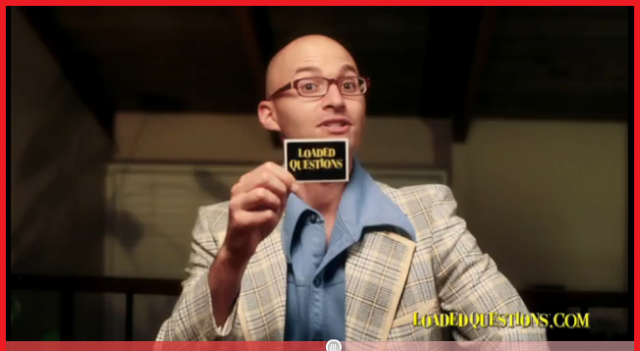
Video doesn’t have to be professionally done, and sometimes it’s better if it isn’t. A super polished video of customer testimonials could be suspect. The best is a rough video from an actual customer, as it has realism you just can’t beat. But when getting into advertising, there is an expectation of some polish. Here’s an example of a video produced by one of our directors, Snehal Patel, for the game Loaded Questions, starring Eric Schwartz, aka Smooth-E:

Loaded Questions video produced by Snehal Patel, starring Smooth-E (Eric Schwartz)

While you might not be prepared to launch into a custom video production today, it’s a good idea to at least include it in your market development strategy. By spending some time with an experienced production company to outline some ideas, you will be a few steps closer to creating great visual content. A good video backed by decent market research data collection can go viral, and be passed around to hundred and even millions of people for free.

If you have a product that customers like to see before they buy, video is going to be crucial. If YOU are the product, photos and video could play a big part in your success. Potential customers appreciate the chance to meet you online prior to meeting you in person. Besides, it can save you a lot of time too, as customers who have already met you online, probably have already decided to work with you by the time they request an in-person meeting.

Most social media sites allow videos to be posted.  Social Media is a great place to start posting customer testimonial videos. Facebook business Pages allow fans to post their own video. Consider providing an incentive for clients and customers to post a video describing their experience with you, etc. At the very least, incorporate taking photos relating to your business, and get them posted online with a caption or description. Since Google can’t “see” the photo, it has to have some text describing the photo to index it properly.

Topic Optimized Marketing: An Overview

Free tools abound on the internet for marketers. It’s great that pretty much anyone with a will to learn and an internet connection can bootstrap their way to higher income by using free tools.  It really levels the playing field in a lot of ways.

But there is a risk involved. Free tools mean you have no rights other than what a company is saying you have. If you violate their terms (and even if you don’t), any social media presence you’ve “created” online can be taken away from you at any time.  Because of this, I have been searching for a solution that was both easy to use, and provided a majority of “ownership” for the user. This isn’t a solution for the faint of heart.  It’s real enterprise social media at its best. We call it Topic Optimized Marketing.

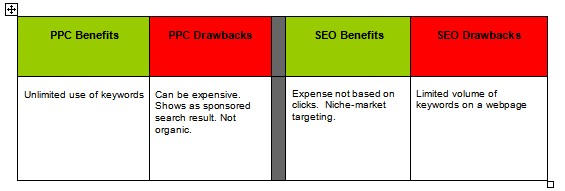
Benefits and drawbacks of PPC and SEO for effective marketing plans

Topic-Optimized Marketing software is an easy to execute platform for targeting large numbers of keywords and ranking them on organic search results. It allows a company to do the following:

  • Target keywords for a business in organic search to win more traffic
  • Decrease cost per lead, and increase the efficiency and productivity of content creation
  • Drive qualified traffic which in turn increases website traffic
  • Frees up as many people as possible to create content (or we can create it for you)
  • Leverages content across a network of keyword-based blogs, not just one blog

It also provides the following benefits:

  • Unlimited use of keywords (represent as many as needed)
  • Search engines put high value on pages that are frequently updated SEO right out of the box, no expert knowledge of SEO necessary.
  • Conversions of 3%-18% (websites are 1.5%-3% if they are really good)
  • Admin security allows multiple authors to create content while keeping brand messaging consistent
  • Metrics on a weekly basis to track success and ROI
  • Scalable, able to target as many keywords as you want
  • No software to maintain or update
  • Workflow built for busy professionals
Because Topic Optimized Marketing titles each blog to match a keyword search term or phrase, allows unlimited post volume, and creates links to websites, we are able to maximize the chances of the blogs ranking well on Google.  Adding carefully done long tail keyword research helps create relevance and a much higher conversion rate.

Of course, don’t just dump your Pay Per Click campaign.  If it’s working, keep it unless you can produce more leads for less money with something like the above. Keep in mind that any marketing campaign that “doesn’t work” might be suffering from a lack of some kind of consumer analysis. There is no replacement for really understanding and speaking to your customers.

Topic Optimized Marketing might not be the right solution for your company right now, in which case feel free to use whatever free tools are available. Just be aware of the risks, and as soon as you can, work in some online real estate you can “own.”