DSLR Convert

Johnson Liv took our Pro Level I Boot Camp in May of 2011 and is still reaping the benefits today. Thanks for the update, Johnson! We look forward to seeing more of your work in 2013:


Hi Fletch and Canon Boot Camp team,

Took your beginner's course in early 2011, but met you guys mid 2010 at the first PhotoCine show. I switched from a Nikon D90 to 7D immediately after PhotoCine. The Canon DSLR video craze has really spread and everyone owns one, however not all know the full potential settings, I still get other owners coming up to me asking for advice on certain settings, ways to approach audio issue, picture profiles, etc. I've already had plenty of return investment from the course alone many times over and still working today with an online site. The studio just happened to own two 5dmk2 , and also three Panasonics which sees occasional use. I have recently sold my 7D and confidently purchased the 5dmk3 and looking forward to putting it to use. Thanks to the great team and hospitality, Snehal, Tom, Fletch, Chris and the Boot Camp family.

Here's the latest vid I got to shoot using the 5dmk2:


Name: Johnson Liv
Company: nineoutof10
City: Los Angeles
State: CA

HDSLR Lens Sharpness Test

Which lens is the sharpest for HDSLR digital filmmaking?

We can’t answer that definitively.  But it’s a close race.  On a large movie theater screen we could see certain lenses pull into the lead.  But for now, on the internet, we’ll have to settle for the best resolution Vimeo offers.

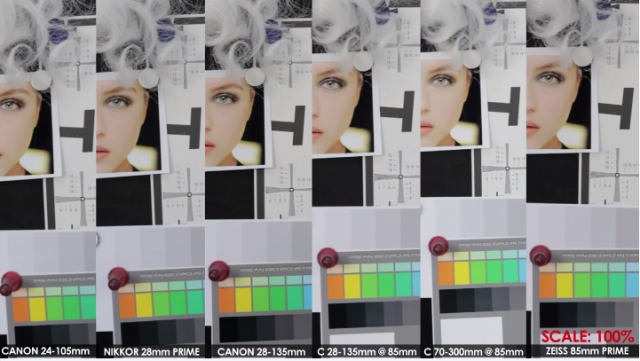
Sharpest Lens for HDSLR Filmmaking Test Panel

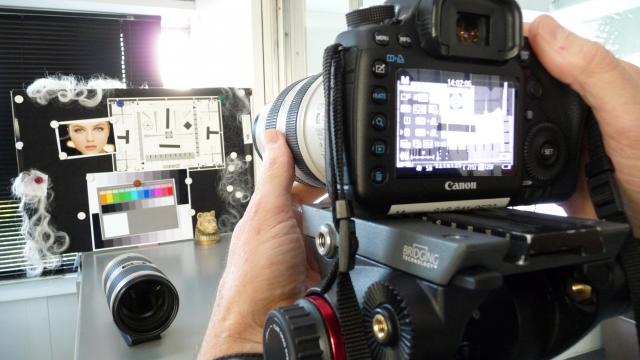
(above – The imagery we put up to test the lenses.)

These tests came about because I wanted to see, like most digital cinematographers, what’s the sharpest lens…especially when you’re shooting with the full-frame Canon 5D Mark III.  We were tired of listening to internet “reviews” and “opinions”. We wanted to see for ourselves.  We compared the “average” lenses in use today with the top drawer Zeiss CP.2 85mm and a lens I bought in college, the Nikkor 28mm f 2 prime. (It cost me $279.  In Obama dollars that Nikkor cost me $2,790.)

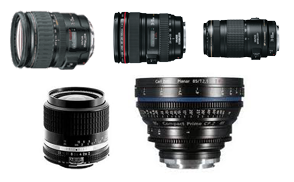
The 5 lenses used in our HDSLR Digital Filmmaking Lens TestWe tested five lenses: three Canon Zoom (the EF 28-135mm f/3.5-5.6 IS USM, the EF 24-105mm f/4L IS USM , and the Canon EF 70-300mm f/4-5.6 IS USM),  the Zeiss 85mm CP.2 prime and an oldie but goodie Nikkor 28mm f2 prime.   Note the white fine hair, which sometimes makes it much easier to pick a leader.

Which one is the ultimate focus winner? What’s the best wine? What’s the best city to live in?  We don’t like to tell people what to think.  Decide for yourself.  Let us know your pick in the comment box below. If you have your own test results you’d like to share, email trevor@theassociation.tv.

7 HDSLR Lens Test Results

Of course, if you are shooting a feature with critical focus shifts, the Zeiss CP.2 will trounce the other lenses. It focuses like butter in tiny increments unmatched by most lenses.  Of course, if you’re not shooting a feature yet but want your film to look like a feature, it’ll make you look very good.

We’ll review the Canon “L” series lens next.

Test three lenses


Three tips on how to pick lenses for Canon HDSLR filmmaking

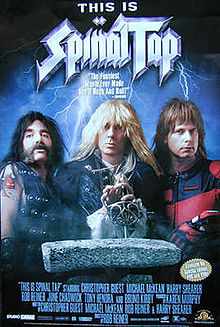
Spinal Tap Rerelease Poster courtesy of  WikipediaChoosing Your Canon Lens.

Spinal Tap is one of my favorite movies.  In it, Michael McKean makes the point that his amp goes to eleven.  (Even though “11″ is really the “10″ on the dial.)   There’s a parallel between Michael and the filmmakers who insist their lens must be an f 2.8 lens.  Let me explain.

The worship of an f 2.8 lens is a holdover from film days.  Film only went up to about 500 ISO.   An f 4 just wouldn’t do.  That was certainly true back in the day, because film stocks, with their relative low ISO’s begged for fast lenses.  Probably the epoch of this era was Stanley Kubrick and the lenses he had made to shoot ‘Barry Lyndon’.  (They are on exhibit at LACMA, which we’ll visit next week for another report on Lens Worship.)

But things have changed at least for digital SLR filmmaking.   Digital still photographers still need faster lenses because they’re shooting at 1/150th of a second.  Video lives between 1/60th and 1/50th of a second.  So digital filmmakers have less need for f 2.8 and f 2 lenses.  Since we now have Canon enabling clean digital film shots at ISO 2500 on the Canon 5D Mk III, we can live happily with an f 4 lens.  Here are some other pluses to consider before you choose a lens:


1) The f 4 lens lets us have an extra inch or two depth of field over the 2.8 lens. Isn’t that a blessing?  Or would you rather be out of focus more often and hope the director was so impressed with you bringing that big heavy 2.8 lens with you to the shoot that he won’t fire you?  Maybe if you supered across the bottom of the out of focus shot, “Pardon the fuzzy picture. But just so you know it was shot with a very expensive lens.”

2) if you really need to go to 2.8 and your lens only does f 4 you can always take your shutter speed from 1/50th to 1/30th and open up 2/3 of a stop.

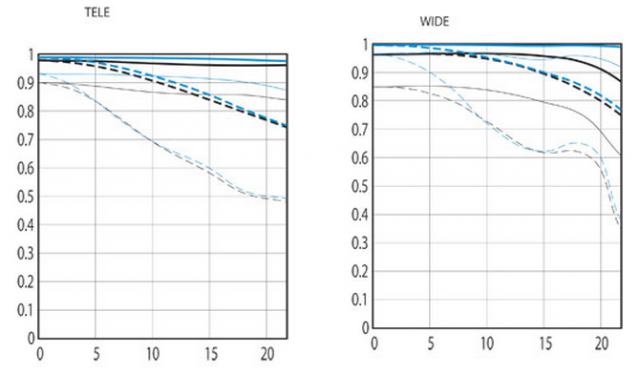
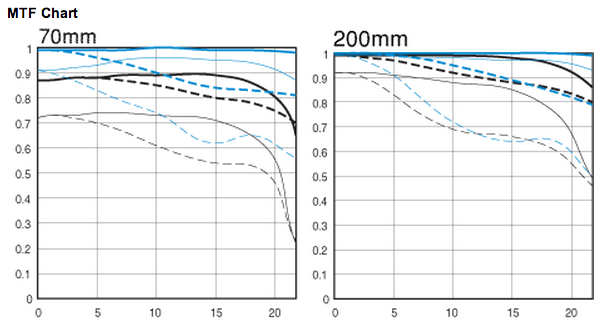
3) If you check the MTF charts on the Canon site you’ll find that the f 4 lenses are better performers in microcontrast and resolution (according to Canon).

MTF graph 70-300mm f 4 - 5.6 L is usm

MTF chart - EF 70-200mm L is II USM

(Note the bottom graph has the wide (70mm) on the left, the top graph has the wide chart on the right)

An MTF chart is supposed to track a lens’ ability to render microcontrast and resolution.  Some say the charts aren’t relevant because your can’t see any difference.  But it’s the only scientific measurement I’m aware of and thus is a guide you can use for objective reality.  Decide for yourself in your own Canon lens tests.

Understanding MTF Charts

By the way, here’s how to read an MTF chart, according to Canon:

VERTICAL SCALE 

Between .8 – 1  Good Contrast

Below .6 indicates Problems

HORIZONTAL SCALE

0 is the center (left side of the horizontal scale)

20 is the outer edge of the lens (right side of the horizontal scale)

Black Line is Wide Open

Blue Line is ½ way stopped down

Thin Black line = Resolution

Thin Blue Line = Resolution

Dotted Line = Quality of Bokeh (out of focus). 

You want dotted lines close together.

So as you shop for your next Canon lens, don’t close the door on the f 4s.

I’m convinced f 4 is the new 2.8.

And if you still have the thirst for f 2.8, I have some stickers I can send you to paste on your lens.  You can be like Spinal Tap with an amp that goes to eleven.


Ten Tips for Buying Lenses for Canon HDSLR filmmaking

Tips on Must Have Camera Lenses
When Canon lowered prices on select lenses many HDSLR filmmakers started considering their next purchase and giving their relatives baked goods for the holiday season.   Here are some quick tips for filmmakers.  They don’t necessarily apply to still photographers:
1) THE LENS IS FOR YOU.   Maybe you want to be a National Geographic photographer.  Me too.  But you don’t have to buy the lens that the guy in Alaska used to shoot the arctic wolf a half mile away.  If you do, you’re just buying a lens to be like him (or her).  Listen to their tips but make your own career choices.  One of our students at our December Canon Boot Camp brought a Canon 15mm f 2.8 fisheye.  He tends to shoot a lot of underwater film in underwater housings.  Great choice for him.
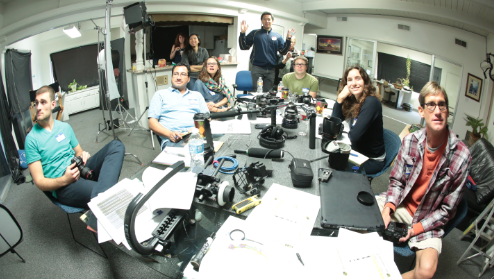
Fisheye of 1Dec2012 Canon Boot Camp at The Association
2) LIST WHAT DO YOU LIKE TO SHOOT WITH THE LENS. Base your lens choice on what you’ve been shooting in the past and what you’ll probably be shooting in the future. Look for a lens that’ll fit in your world.  If you shoot outdoor sports why are you buying a lens to shoot in deserted Mayan ruins?
3) ONLY ONE IMAGE WILL BE ON THE SCREEN.  Remember, no one will ever see your film next to another version of your film shot with another lens.  The audience should be watching the story and you should be working on your storytelling skills.  No one knows what cameras were used on most films, or cares for that matter.  Your audience is there for the story.
4) BUYING THE LENS WILL NOT LAND YOU A JOB. No matter which lens you buy, you still have to go out and find a client.  Those skills do not come in a box.
5) FILMMAKING IS ABOUT MOTION NOT FREEZING A MOMENT IN TIME. Film is tracking moving objects.  And it shoots usually at 1/50th or lower.  Shane Hurlbut likes to shoot at 1/40th.   I shoot at 1/30th sometimes.  Still photogs still need faster lenses because they’re shooting at 1/60th and higher. So a lens that will stop down to f 2.8 or f 2 is of great interest to the still photogs.
6) HOW CAN I GET BY WITHOUT F 2.8? By changing  your shutter speed from 1/50 to 1/30 gives you 2/3′d of a stop.  It will be so close to what the 2.8 lens sees as to be virtually indistinguishable.
7) YOU’RE GOING TO STOP DOWN ANYWAY TO CRUSH THE BLACKS.   Kodak never made motion picture film as fast as the ISO’s today.  So the thirst for f 2.8 is left over from the film days with its slow ISOs.  The Canon Mk III shoots fairly clean at ISO 2500.  Digital Filmmakers, wanting the “film look”, usually stop down anyway to “crush the blacks” and make it more like film.
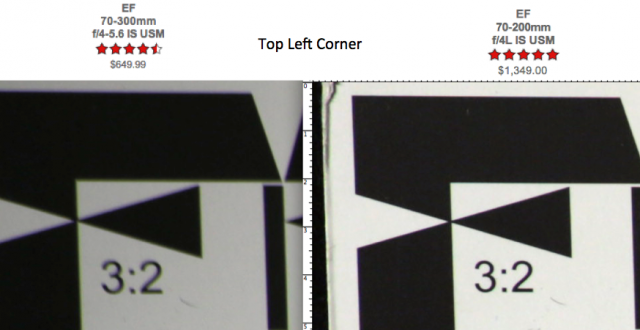
8) L series – This is something worth the extra bucks.  Definitely look for this. See the non “L” lens below on the left compared to the “L” series 70-200mm f 4 is usm on the right.  The 70-300 mm was brighter in the middle with darker vignettes around the corners.  The L series zoom was exactly the same exposure all the way across.  Also note the purple edging and general softness.  You just don’t know how soft until you put them side by side under controlled conditions.  More of these tests are coming.
70-300 f 4-5.6 is usm vs. 70-200 f 4 is usm
9) IMAGE STABILIZATION – Another must have.  Worth every penny.  It corrects the jittery nature of handheld shots being captured at 1/40th or 1/50th of a second by the filmmaker.  Still photogs are freezing the action with their shutter speed (like they’ve done since the beginning).
10) TRY BEFORE YOU BUY – I’m on my third trip to Samys.  I bought the 70-200mm f 4. Then the f 2.8. I want to buy another lens but what I should have rented them first but I rushed to judgment because the $400 rebate ended Sunday, I thought, and I felt I had to go for it.  Turns out it runs to Jan 5, 2013 now.  I’m still testing lenses.  The tests will be up next week.
11) ADDED BONUS TIP:  RENT ‘TIL YOU CAN’T DO WITHOUT IT.
Falling in love with a lens doesn’t mean you have to take it home.  Date your lens first, i.e. just rent it for jobs you’re doing.  When you’ve had a chance to get to know it, then, you can propose marriage.

EXTRA BONUS

FOLLOW YOUR HEART.  It is smart to eview lens tests on the web but follow your own counsel.  If you love a lens, get it.  My first camera had three interchangeable lenses. The telephoto distorted the picture in the most beautiful way.  Sharpness was important but liking the lens comes first.  I’d love to run some film through that old camera.  Sorry I sold it.
Good luck.   If you’d like more lens comparisons, resolutions tests, etc.  go to our Vimeo site www.vimeo.com/paulfletchermurray
It’s great to see objective data rather than listening to web “experts’” opinions.

DSLR Filmmakers Comment on the Canon Boot Camp

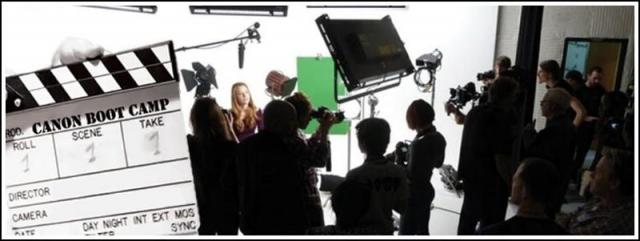
We take our DSLR Filmmaker training seriously.  So we always ask at the end of each Canon Boot Camp for feedback and comments, to take the training one step further.  This past weekend saw the conclusion to our December class. Here’s a couple interesting question we asked each participant, and some of the responses:


What goals did you set for this workshop?” and “Did you achieve your goal for the workshop?”:


DSLR Filmmaker Training at the Canon Boot CampGoal: How to operate the Canon 5D Mark II. How to achieve a cinematic look. Different types of lenses and what look they have.

Achieved?:  Yes I did.

Goal: Getting to know and being able to sue the canon 7D. Learn about possible set-ups with rigs and sound.

Achieved?: Yes! I still need much more practice, but I got the tools to go out on my own now.

Goal: (Not stated)

Achieved?: Absolutely!

(Hey, that just shows that even if you aren’t sure what you’re doing with your camera, you’ll still achieve something worthwhile by coming to the Canon Boot Camp! It’s that good.)


Goal: Further improve my knowledge of DSLR

Achieved?: Yes

Goal: Learn more about the camera’s settings, how to smoothly change focus, what some lighting setups are.

Achieved?: Yes!


The Canon Boot Camp on location

We’ve caught wind in the past that some classes about filmmaking tend to be a bit on the ego side, where the main topic is what the instructor has done in the past. We work hard to ensure that the class is about the students, not about the teachers.

This attitude is carried through by the entire Canon Boot Camp team. Just to be sure, we ask a final open question, “Anything else we didn’t ask you about, but you’d like to say?” So here’s a few parting comments that reflect the overall attitude and “air” of the Canon Boot Camp:


A big thanks to Fletch and all the other instructors. You were/are very helpful. Also, thanks to Nancy for the nice food spread.  R.R.

The instructors and support staff were great! Very friendly and helpful. I’m glad that we had a good ratio of students and instructors.  M.L.

Everyone was extremely accommodating & nice beyond my expectations. Thanks you! You treated everyone like family. A.H.

Thank you so much! This has been great fun, an exceptional atmosphere and a lot of valuable information.  C.M.


As always, we enjoyed having all y’all at our “home” and we’re looking forward to your future exploits, be they short, feature or commercial. All the best!

Your Canon Boot Camp Team

Canon Boot Camp in Action

Killer

If you’ve seen the Canon Boot Camp short, “The Sonnet”, you might not expect the plot of our newest short, “Killer”. These two films are worlds apart. While “The Sonnet” is sentimental and sensual, “The Killer” is bloody and thrilling.

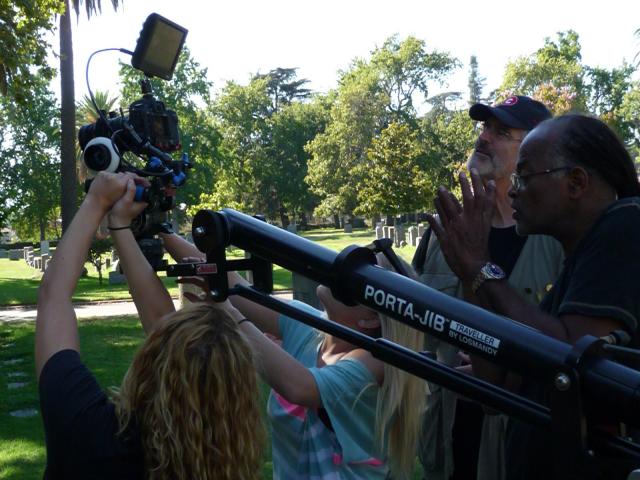
This short took three Canon Boot Camp workshops to complete. With the intricate script, twists, and action sequence, we wanted to make sure that we’d get it right. This even included us going on location to a cemetery, a first for the Los Angeles workshops. As you may or may not know, “The Rose” was shot entirely on location in Prague by the Prague Canon Boot Camp. We hope to go on location more often with the workshop, especially since we are working with such lightweight and flexible Canon cameras.

In total, we had 24 filmmakers shoot this film with amazing and patient actors Anna Easteden, Carlos Reig-Plaza, and Hector Hank.

Join us for our monthly Canon camera classes and be part of this fun filmmaking experience!


The Canon Boot Camp is produced by The Association and is located in Burbank, CA.

Practice Makes Perfect

Persistent Blogging=Great Marketing

Teachers, coaches and mentors can often be quoted saying “practice makes perfect.”  Unfortunately, the thought of practicing a weakness makes people wince, especially when the practice is focused around one monotonous and similar task.  Blogging is different.  It gives people the opportunity to write differently every day.  The content, layout or even writing style can vary which can provide relief from drilling away a.


Thomson the Intern Gets Rigged

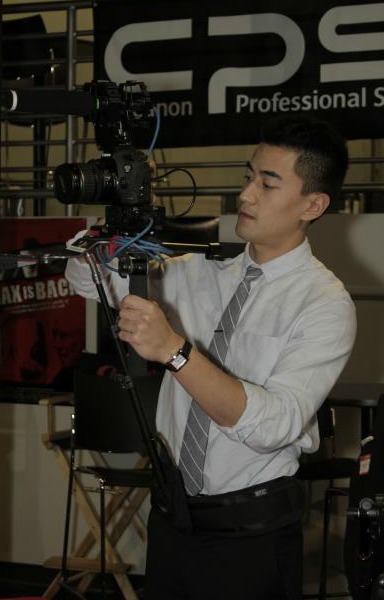
Our new intern, Thomson, helped us out at the November 8 screening event we recently held at the Canon Hollywood Professional Technology and Support Center. Here’s what he had to say about the rig we hooked him up to. The rig included a DVTec MultiRig, and a juiceLink riggy micro hooked to a mic.


Intern Thompson Take on a Multi-Rig

“Last Thursday I had the pleasure of handling our production team’s DVTec Multirig and, boy, was I impressed. The Association held their Boot Camp premiere at the Canon Hollywood Professional Technology and Support Center  and I had the responsibility of covering the event. I never handled a DVTec MultiRig before and was uneasy that I very well may capture three hours of useless footage.

“To my astonishment, the DVTec Multirig was easy to learn for any beginner and relieved my concerns. The MultiRig was compatible with most DSLR so propping on our Canon 5D Mark III was not a problem. I was even able to secure a juicedLink riggy micro and mic along with it. The juicedLink preamplifier offers quality recordings for anyone capturing sound with a DSLR. I could simply adjust the sound levels to limit distortions and it eliminated the hiss you would typically hear from the camera’s mic.

“Having one was essential for tonight if I needed to interview any of the participants. The rig came with an adjustable waistband for your convenience and a handy shock-absorbing stabilizer. This stabilizer equips to your waist making it painless for anyone holding the camera for prolonged hours. The combination of the three (shoulder rig, waistband, and stabilizer) produced smooth effortless footage. With a few simple lock and snaps I was ready to go in seconds!”


Our First Annual Canon Boot Camp Screening Event was a Success!

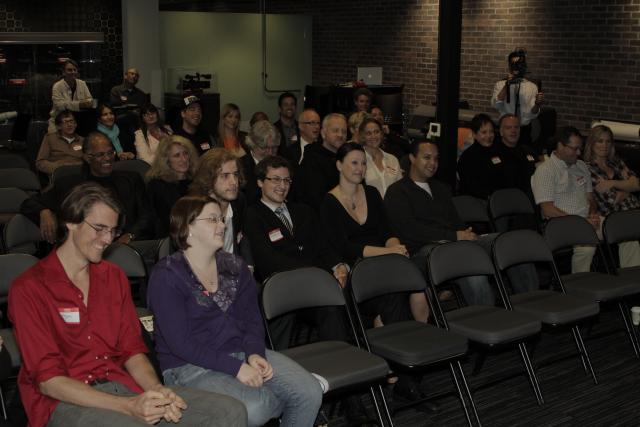
Here at the Canon Boot Camp, we’ve been “recovering” from our first annual Canon Boot Camp screening event which took place last week. It was so much fun! Thanks to Amy Kawadler of Canon USA, we were able to host a premiere at the posh Canon Hollywood Professional Technology and Support Center on Sunset Boulevard.

The night started with guests rolling in, despite the rain and traffic (thank you!), and feasting on scrumptious nibbles from Fabiolus. Amy then welcomed the crowd and explained that we wouldn’t have been there that night if it wasn’t for a little camera called the 5D Mark II. She introduced us to her wonderful staff, including Tim Smith, Mason Higa and Thomas Rose. Next, Fletcher Murray, President of The Association and Chief Instructor of The Canon Boot Camp, took the stage to kick off the screening of the 8 short films completely shot by Canon Boot Camp participants.

_mg_0103_w640

The short films included: The Nun Who Lied, The Sonnet, Just a Second, Escape, Hooker, Killer, Big Dave, and The Rose.

The event was also the World Premiere of The Rose, which is a short film shot in collaboration with creovision, a Czech production company who brought us to Prague to teach two 2-day workshops with 38 students. In 2 shoot days, I am amazed with what we accomplished. Being on location at the historic Prague train station and filming on an old train car made the experience even better. Markus Krug, who helped make the Prague Canon Boot Camp possible, was with us at the Premiere event, which was live streamed to the participants in Europe.

Now we’re motivated more than ever to keep producing thrilling, heartfelt, funny, and emotional short films at Canon Boot Camp workshops so that next year we can once again showcase the work of our amazing participants. Look out for the 2013 Canon Boot Camp dates, and join us, won’t you?

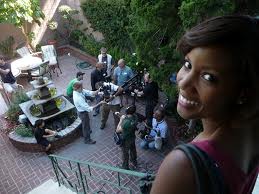
crew

Thank you to Canon, our actors, sponsors, and everyone who helped make this possible!

sponsors_new

Myrdahl helps Boeing to gravitate toward the Canon DSLR 5D Mark III

(This report comes in from Tom Myrdahl, who’s on assignment with the Boeing Company in Seattle. Tom Myrdahl, our 5D Guru and Canon Boot Camp crew member, had been communicating with Frank Buck, Manager of Boeing Seattle’s Creative Services and one of their top Producers Dean Jones. Tom’s been telling them about “the Look” of the 5D.   Coincidentally, a project of importance ended up on Dean’s plate that Dean felt it was the chance to try out the commercial look that the 5D could offer. So Tom was off to Seattle.  Here’s how the Canon HDSLR is doing at Boeing, which up til now has been an “all Nikon” company. Tom went up to Seattle to advise them on what and how much support equipment to get.)

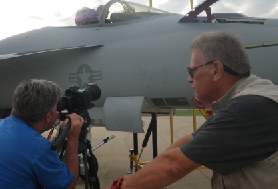
Jim Lally and Tom Myrdahl on location

Frank Buck and Dean Jones were excited about the project as were two of Boeing’s best cameramen, Jim Lally and Tom Wallace. Within a few weeks the new 5D Mark III arrived.  The Compact Flash cards, HDMI cables, and other items arrived just in time for all of us to get on a plane and head off on a three week trip to St.Louis, Washington DC, and Huntington Beach California. All of us saw the quality of the 5D. The contrast and colors are more film-like.  Lighting like you would for film delivers a great look.


(above – Jim Lally and Tom Myrdahl on location)

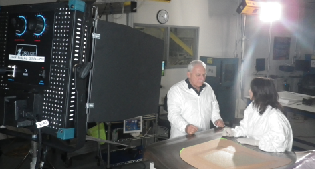
Dean Jones & 5D in the space lab.

(above – Dean Jones with the 5D in the Space Lab.)

All involved saw that this camera is not an ENG camera but must be treated as if shooting a commercial. The depth of field issues clearly demanded care and precision on focus …this demands precise camera movement and commercial style lighting techniques…which were more easily done with daylight balanced  LED Panel lights by Zabo, and HMI Jokers…all went well.

Zabolights on set.

(above – the adjustable Kelvin temperature Zabolight on set at Boeing)

These last three weeks may indeed change the way Boeing Seattle shoot their hi-end videos from now on.

(Good work, Tom.  We’ve been working on Boeing for nearly two years now.  Happy to hear it went well. – Editor)