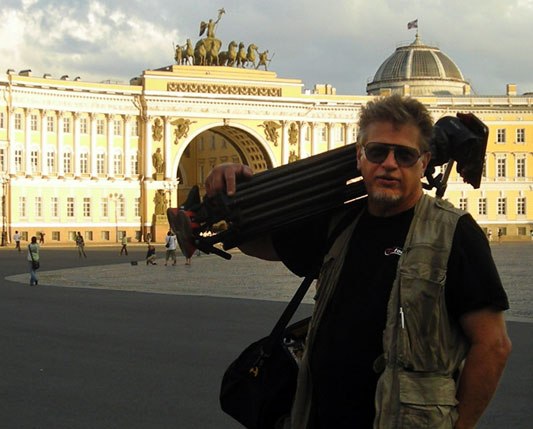
Tom Myrdahl: Cinematographer Extraordinaire

Tom Myrdahl: DP at The Association

Where are you from and where the heck have you been for the last 25 years?

I’m a California boy, born in Pasadena. I went to film school at Loyola Marymount and specialized initially in documentary. I made several award-winning projects in my early period, then I went to work for the UN and did projects in Asia. When I came back I got into the IA. I was an assistant cameraman along with having my own production company in Hawaii, where I worked on series shows and shot documentaries that were pertinent to Hawaii at that time. 

After I came back to the United States, I lucked out and got a job with Lockheed, now Lockheed Martin, and started a career that really never stopped. I’ve been with Lockheed Martin for 25 years. I’ve shot projects with the [aircrafts] SR71, 117, F22, and the F35, shooting most of their commercials in the last couple of years and specializing in their product web videos. Everything I’ve been shooting with Lockheed has been with the Mark II 5D. We’ve gotten such good results that Lockheed Martin no longer shoots anything with their agency. We do everything for them, so it’s been a really great experience. We already have over thirty projects lined up for next year.

What do you do here at The Association?


I’m a Director of Photography at The Association. I also help them put together camera packages and help them analyze creative shooting elements in a script they might have.

Favorite camera?


The favorite camera that I’ve been using right now has been the Mark II 5D, and I’m looking forward to this new C300 and other cameras that Canon will be bringing out.

Most exciting project you’ve ever done?


It’s hard to choose, really. I’ve had a good experience shooting Lockheed Martin’s aircraft carriers. I’ve had great experiences shooting the SR 71, which is the CIA aircraft that spied on Russia for 40 years. Airplanes have been a big part of my life. Also, when I was getting my M.A. at Loyola, I was very much involved in the Chicano movement in East LA and with one of the films I did, I ended up going to about eight riots. The last documentary I did for them was the Chicano moratorium when Ruben Salizar was killed. It became sort of the pivotal event between Los Angeles and the Chicano community. I was honored to give them a twelve-minute documentary on that, which became sort ofa historic piece for their movement.

What’s so great about the Canon Boot Camp?


It’s best because it teaches people the basics. They have checklists that the teachers go through with the students on how to set the camera up properly. You end up fully understanding the still camera and video settings so that you won’t end up making a mistake when you go out to shoot something.  What’s really great about this boot camp is that it not only teachers you how the camera works but it also teaches you about the pitfalls and mistakes you can make on the way. I use the 5D because it gives me the best picture, although it’s not very easy to work with. When you take this boot camp you’re going to walk away with the knowledge to use this camera properly.


Adobe Premiere Pro vs. Final Cut Pro X in November 2012

Adobe Premiere and Final Cut Pro

Adobe Premiere and Final Cut Pro TrainingIf you’ve been wondering which editing software to purchase, and hoping for a way to test drive both softwares WITH a guide (instead of plowing through ignorantly by yourself), here’s your chance.

Larry Jordan has been helping editors navigate both these softwares for years and is intimately familiar with every aspect between the two programs. Accordingly, we’ve put together two workshops that cover both Adobe Premiere and Final Cut Pro X so you can get your hands dirty and compare.

The Association is pretty well known now for our signature Canon Boot Camp. In the tradition of “Active Learning” we strive for in our Canon camera classes, our digital editing workshops won’t just be a simple adobe premiere demo and a simple Final Cut Pro Demo. No. Larry will be taking you through the actual programs and actually EDIT a project. So bring your laptop and don’t forget the free adobe premiere download or the FCPX free trial! You’re going to need them.

Sure you can stumble your way through random tutorials on YouTube, but why not go the direct route? Dive into both programs with a guide who’s been there and knows the landscape like the back of his hand. Ask questions. Get empowered to make a decision about which software is best for YOUR projects. Larry CAN answer all your questions.

Stay tuned for registration signup form. The class date is set for November 17th, 2012 and will run from 9 am to 4 pm if you attend both workshops. The Adobe Premiere Pro workshop will be in the morning, and after lunch we’ll pick up with the Final Cut Pro X workshop until 4 pm. To get our event updates sign up for our Filmmaker’s Notebook newsletter or Like us on Facebook.

Students Filming Students: Video for Good

Students in Maine are getting busy learning filmmaking (as well as acting) to bring social issues into the spotlight. Project Aware, an organization based in Saco, Maine, has been working on film projects with younger generations since 2003, on difficult topics such as teen anxiety and bullying

Carl Lakari heads up Project Aware and is also a co-founder. The overall purpose of Project Aware is to empower young people to lead, and they achieve this through a variety of projects and programs.

What caught my eye are the films Project Aware is teaching students to create. Here’s an example of a anti-bullying PSA:

There’s so much to Project Aware, I find it hard to describe it in just a few words, so I’ll focus the remainder of this article on their Summer Film Institute for Teens. Imagine empowering younger generations to visually communicate about resolving important issues that affect their own generation? Powerful. Here’s a few results taken from their website:

  • SFI Attendees produces the movie Listen (available on DVD) was produced along with powerful PSAs on cyberbullyingracism and distracted driving.
  • two (13 and 14 years old) attendees created a PSA on parenting that ultimately served as the basis for Project AWARE’s 3rd movie Influenced. This award-winning movie was created at the 2009 institute and is available on DVD.
  • 10 Sanford kids who attended the Institute went back to school, got involved in their film club, and created the award-winning movie April’s Heart
  • a young women returned to her school and created a PSA with her new skills; it received rave reviews and the commercial was picked up, re-produced professionally and aired nationally.
  • PSA created on teen pregnancy has received over 200,000 views on You Tube and has sparked deep conversation about this contentious issue.
  • Recently an 8th grader used his PSA and story on bullying in his hometown; it now airs on broadcast TV in Maine and he was nominated and chosen as a top 10 finalist for a $10,000Colin Higgins Youth Courage Award from thousands of applicants nationwide.
  • 4 young women created a powerful video about sexual assault as they processed their own childhood experiences. Sexual Assault Response Services is planning to use the PSA for education in schools.
  • finally, a 14 year old teen was able to write, direct, and lead in her own movie about the healthy passions of youth. A Shoestring for Mackenzie is planned for a 2012 release.

Tell me, where do you find such programs today? Far and few between. So when you find one, be sure to support it in any way you can. Love filmmaking? Foster it in the younger generations. You can donate or possibly offer your time as an instructor.  At the very least, share this article with your fellow filmmakers and spread the words.

Good deeds deserve to be shared, don’t you think? Know another filmmaking-related project worthy of a little recognition? Let us know by communicating to us in the comment box below.

Notes from the Manual: VistaVision – What it is & How it Compares to 35mm Film

Excerpt from the Canon Boot Camp Manual

When Shane Hurlbut says the Canon 5D is equivalent to a VistaVision camera, you
may wonder what he’s talking about.

Briefly, the VistaVision process was created to produce a huge image in the theater.
It uses wider-angle lenses to give greater scope on the big screen. The 35mm
negative travels horizontally through the camera frame (with eight sprocket holes
per frame instead of four), producing a negative image with an area nearly three
times the size of the standard 35mm movie image.

300px-VistaVision_8_perf_35_mm_film.svg

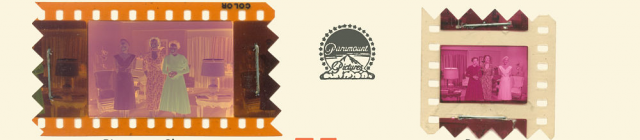
The Canon 5D sensor is as big as a Vistavision frame. Pictured below is a VistaVision negative on the left, and regular 35mm movie film on the right.

VistaVision and 35mm Comparison. Image courtesy of www.hometheaterforum.com

[NOTE: For a full history regarding VistaVision and it’s part in film history, visit the VistaVision entry in Wikipedia.]


The above data is a taste of what awaits you at our Canon Camera Classes, specifically Pro Level I (the first day of our 2 day boot camp). Hungry for more? Download Part I of the Canon Boot Camp Reference Manual by clicking on the red link below.

Download the full Canon Boot Camp Reference Manual

from our Facebook Page


Notes from the Manual: Canon 5D Sensor – Size Matters

Excerpt from the Canon Boot Camp Manual


How Big Is Big?

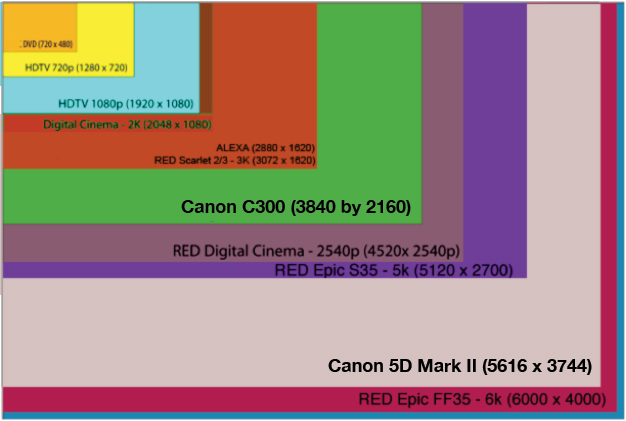
It’s interesting to point out here that the 5D’s sensor is as big as the RED Epic.

Take a look at the illustration below:

Canon 5D Lens Size Comparison Chart


The lavender area is the size of Canon’s 5D sensor.

In other words, the Canon’s 5D is HUGE.

Find the Alexa’s sensor (2880 x 1620). The RED Scarlet has a sensor measuring 3072 x 1620. Even the new Canon C300 is smaller, at 3840 x 2160. The 5D is bigger than all of them, at 5616 x 3744 pixels. It just can’t push a sensor full of data at 30 frames per second . . . YET!  That will probably take faster circuitry which means heat, which means fans and a different camera body.  Even Canon’s new C300 doesn’t have a sensor as big as the 5D Mark II.

Many expect that the Canon 5D Mark III will improve the output specs of this camera, which is already a favorite in Hollywood. Canon introduced their new cinema camera, the C300, with a sensor dimension of 3840 x 2160. That’s 34 percent bigger than the Alexa.

The C300 is also capable of shooting at 3200 ISO with no noise. In fact, skin tones look their best in camera tests at 3200 ISO. It has tiny fans to cool the sensor! AND it has less problems with moiré patterns.

The Canon 5D Mark II still beats the C300 with a 5616 x 3744 sensor image. So in a way, the 5D is still a great choice for filmmakers on a budget.

Download the full Canon Boot Camp Reference Manual from our Facebook Page.

How to Make a Video Viral

Pretty much anyone involved in custom video production is going to tell you video is an important part of any effective marketing plan. And we’ve all seen those videos with millions of views that make it to the top of the list. With that kind of example, the idea of having a viral video can get tweaked in the wrong direction.

First off, a viral video doesn’t mean that it has to have millions of views. That’s good for small business owners. If you own a small coffee house with a local clientele, is it really going to help you if millions of people see your viral video?


Here’s another problem. What determines when a video will be viral? Many of the viral videos went viral due to their entertainment value. Funny, amazing, interesting or whatever it was that clicked and it just got shared by a LOT of people all at once. Some of those moments just happened to have been captured on camera and weren’t rehearsed.

And how many funny commercials have you seen that everyone can talk about, but they don’t remember what company or product was being represented. They remember the video, but couldn’t tell you the product.

What’s the point of all the promotion if it doesn’t lead to sales? NOTHING!

I offer you this advice. Get busy creating content on a blog, including video content. Make sure you include written descriptions on YouTube or wherever you’re hosting your content since search engines can’t “read” video, which hinders indexing (for search results). Anna Easteden, Actor

Here’s the hot tip. If you share all of that content on social networks like Facebook people have the chance to share the content. If you write and video about OTHER people and share it with them, they sometimes share it with their friends who share it with their friends.

Even if you don’t get millions of hits, you can get twenty, thirty or more hits you wouldn’t have gotten otherwise. Free exposure. Who’s to say what might happen if you do it consistently? And if it’s being shared, even by just a view, it still is viral. It might not be famous, but it’s viral.

On of the most popular blog posts we had was written about an actor we’ve used in our Canon Boot Camp several times. I interviewed her, wrote a blog post promoting her work with us, and the other projects she was doing, and shared it with her on Facebook after I posted it on our blog. She went on to share it with her network, and before long, we’d had nearly 100 hits on the article.

So just consistently create and share content and you’ll win out over about 80% of your online competition.

And while you’re here, if this article helped you in any way, please share it on Facebook or Linkedin!

Notes from the Manual: Squeezing the Picture Down 10 Times

Excerpt from the Canon Boot Camp Manual

As you squeeze down a 21 megapixel picture 10 times to fit the 2.0 megapixel picture High Def TV (HDTV) requires, lines of information begin to overlap. This is extraneous information not needed to form the much smaller HDTV picture.

Extra Info on a Smaller Frame Size

The HDTV frame size was so small that Canon could actually eliminate the two-thirds of information it was processing. This further reduced the demand on the circuit boards.

Reduced Frame Size

So Canon’s 5D (and 7D) circuits only output every third line and still retain a High Def TV (2.0 megapixel) picture.

5616 pixels wide / 3 = 1872 pixels wide

3744 pixels tall / 3 = 1248 pixels wide

Then, they worked a little magic and give or take a few pixels, Canon had a 1920 x 1280 picture.

RECAP: They reduced the volume of data coming off the sensor, making it possible for the circuitry to process HighDef, 30-frame-per-second video without putting cooling fans and faster processing cards into the Canon 5D. It’s called line skipping.

LINE SKIPPING: The 5D Mark II and the 7D are “line skipping” cameras when in movie mode. They skip two-thirds of the lines of information. The 7D’s sensor is physically smaller than the 5D’s but still holds 5184 x 3456 pixels.

Download the full Canon Boot Camp Reference Manual from our Facebook Page.

Notes from the Manual: The Canon EOS Camera

Excerpt from the Canon  Boot Camp Reference Manual

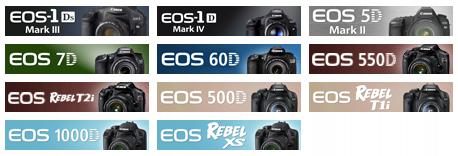
Canon EOS Cameras – The 1D, 5D, 60D, 7D, T3i, and T2i are in the family of digital still cameras. Hundreds of Canon lenses are available for these Canon cameras.

Canon EOS Cameras

Electrical Contact Points on EOS Cameras

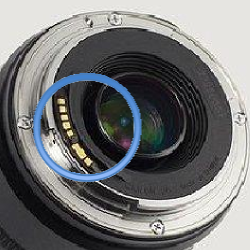
EOS stands for Electro-Optical System. There are electrical contact points on these lenses so the camera’s computer can operate the lens f-stop and focus. Data about the camera settings also passes from the lens to the picture data.

The EF lenses have an “Electronic Focus” capability. Data from the sensor is transmitted to the lens to adjust focus until the sharpest picture is found. The EF lens is popular and other manufacturers make EF lenses.

Canon EF lenses are available all over the world. You can rent them easily and you’re never far away from a back-up lens if you need one.

Download the full Canon Boot Camp Reference Manual from our Facebook Page.

Women More Likely to Use Social Media

Women More Likely to Use Social Media

Does your marketing development strategy ignore women?

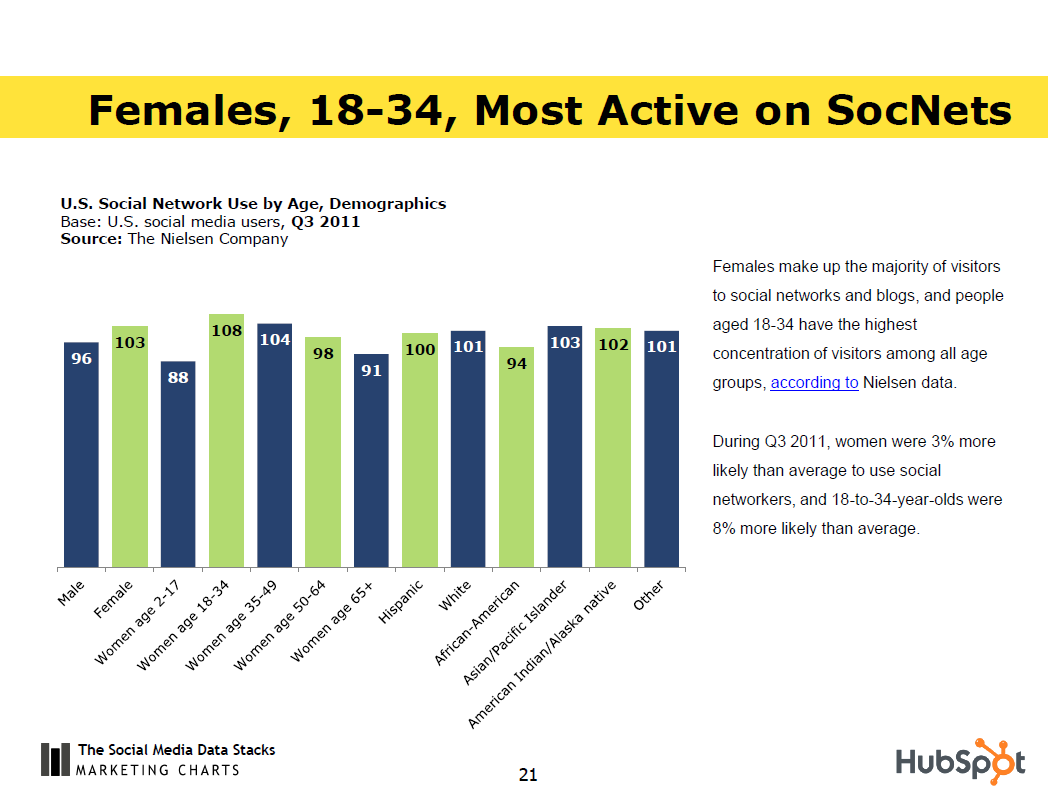
According to The Nielsen Company, the majority of visitors to social networks and blogs are of the fairer sex.  The highest concentration age-wise is the 18-34 year range. If you think about it, it makes sense because in real life women are naturally better networkers anyway. Well, at least the ones I know are better networkers!

Check out the messages going out on your Facebook Pages and the articles on your blogs. Would they be appealing to women as well as men? Obviously, if the entire site is dedicated to women already, there’s probably no issue. But what about business like auto repair, typically a male-dominated industry pre-internet, or even a sort of “neutral” business like pet stores?

I’m not suggesting that all of your enterprise social media posts and articles be aimed at women exclusively – just suggesting you review or audit current and past postings to assess who you’re really talking to 24/7 online.  And follow it up with content and altering your website to appeal more to women as well, if necessary. Because once people find your blog or social presence, landing on your website is usually just a link away. So the rest of your presence needs to be congruent as well.

Not sure how your content comes across? Well, ask your female friends for their opinion! Then listen to them and take action.

Two-Day Canon DSLR Workshop is Expanding!

The Canon Boot Camp

We have been busy busy at the Canon Boot Camp.

Three years of training hundreds of students, and boy do we have it down. We’ve been exceeding training expectations at our Canon DSLR 5D Boot Camp longer than anyone in town. This isn’t training for the faint of heart either! It’s fun and students really appreciate our hands-on approach.  The Canon Boot Camp is down and dirty training and students walk away with, not only “dirty hands,” but amazing footage they can use on their own reel.

And they get our Canon Certification as well as a listing on our website.

Check out our most recent short film,  a romantic one to boot, created from Canon Boot Camp footage, entitled, “The Sonnet.”  And there’s more short films on the way. Make sure to stay tuned and sign up for our newsletter if you’re not already getting our updates!

Sign up for our Email Newsletter

Over the past three years, we have worked constantly to upgrade and improve the class as much as possible. There is a specific result we are going for in each student. We don’t want to just listen to ourselves talk. We’ve all been to one of those seminars, right? No, we want you to walk out the door with increased ability and a certainty that your money was well spent. So hundreds of hours (maybe even a couple thousand if you include the on-the-ground-work and training we’ve done) have gone into course improvements.

Take the Canon Boot Camp Reference Manual, for example. Did you know you can get a preview of Pro Level I before you take the class, for FREE? Yes, you can download the Canon Boot Camp Reference Manual right from our Facebook Page, at no cost to you.

Once you’re at the class, we take a lot of care to ensure each person, beginner and pro, really understands AND CAN APPLY the course information.

During this 3-year developmental period, we have kept the cost of the class low. But now we find that in order to expand, we must raise the investment required by each student slightly so we can continue to improve and expand. So the cost of each boot camp will raise incrementally by $75 each month until January 2013, where it will stabilize at the new higher amount.

We’ve created registration forms for each class from now until Jan 2013. If you’ve been considering coming to a Boot Camp, you can still get in at the current investment of just under $700 (covers both days, including lunches) by attending the August Boot Camp. But after the August boot camp the amount will go up.

If you’re reading this prior to January 2013, the upcoming events are all listed on the right side of this blog. Just find the date you’re interested in and click on it, and you’ll be able to access the new pricing. And of course, you may always contact us via email or by phone.